
Conway Criminal History Checks
A Conway record check should start with the document, not merely the person’s name. The city police report describes what Conway officers recorded. Municipal Court keeps eligible city matters. J. Reuben Long Detention Center keeps a separate county booking if intake occurred there. The Horry County Clerk keeps General Sessions case events and dispositions, while SLED compiles fingerprint-supported South Carolina history.
Use this order to keep those records apart:
- Confirm that Conway Police Department, rather than Horry County Police, handled the occurrence.
- Submit a focused request through the official Conway police and city information channel, with the report number, date, place, and sought record.
- Contact Conway Municipal Court for a city citation, warrant, scheduled matter, or disposition in its jurisdiction.
- Call JRLDC Booking and check Horry Public Index when county custody or a General Sessions charge may exist.
- Use SLED CATCH for a distinct statewide, name-based South Carolina history.
A missing item in one channel does not erase the others. Recent events may not yet have reached court or state systems, and not every Conway arrest has the same custody route.
Four Conway Record Custodians
Conway’s county-seat role creates an unusual records cluster. A city police report belongs to Conway. A county jail booking belongs to the Sheriff and JRLDC. A felony disposition belongs to the Horry County Clerk. A statewide history belongs to the South Carolina Law Enforcement Division. Walking into the Government and Justice Center does not turn the Clerk or Sheriff into the custodian for a Conway PD narrative.
| Question | Conway-area custodian | Best identifier |
|---|---|---|
| What did city police report? | Conway Police/city FOIA | Report number, date, exact location |
| Was the person booked at JRLDC? | Horry County Sheriff | Name plus booking date or number |
| How did a felony case end? | Horry County Clerk, General Sessions | Court case or warrant number |
| What is in a state history? | SLED CATCH | Name, date of birth, and added identifiers |
That comparison is the fastest way to avoid the wrong line. State and county systems should stay at follow-up depth when the event began with Conway police.
Records at Conway Police Department
Conway Police Department handles incidents inside the incorporated city. The department does not become interchangeable with Horry County Police simply because HCPD headquarters is also in Conway. HCPD serves surrounding unincorporated territory and keeps the reports made by its own officers.
The official Conway police page is the city starting point. Ask the city to confirm the proper records or FOIA path, then describe the record with enough detail to locate it. Useful facts include the report number, event date, exact site, names tied to the event, and whether the request seeks an incident narrative, arrest report, citation, or another named item.
The official Horry County Police directory helps distinguish the nearby county department from Conway’s city agency.
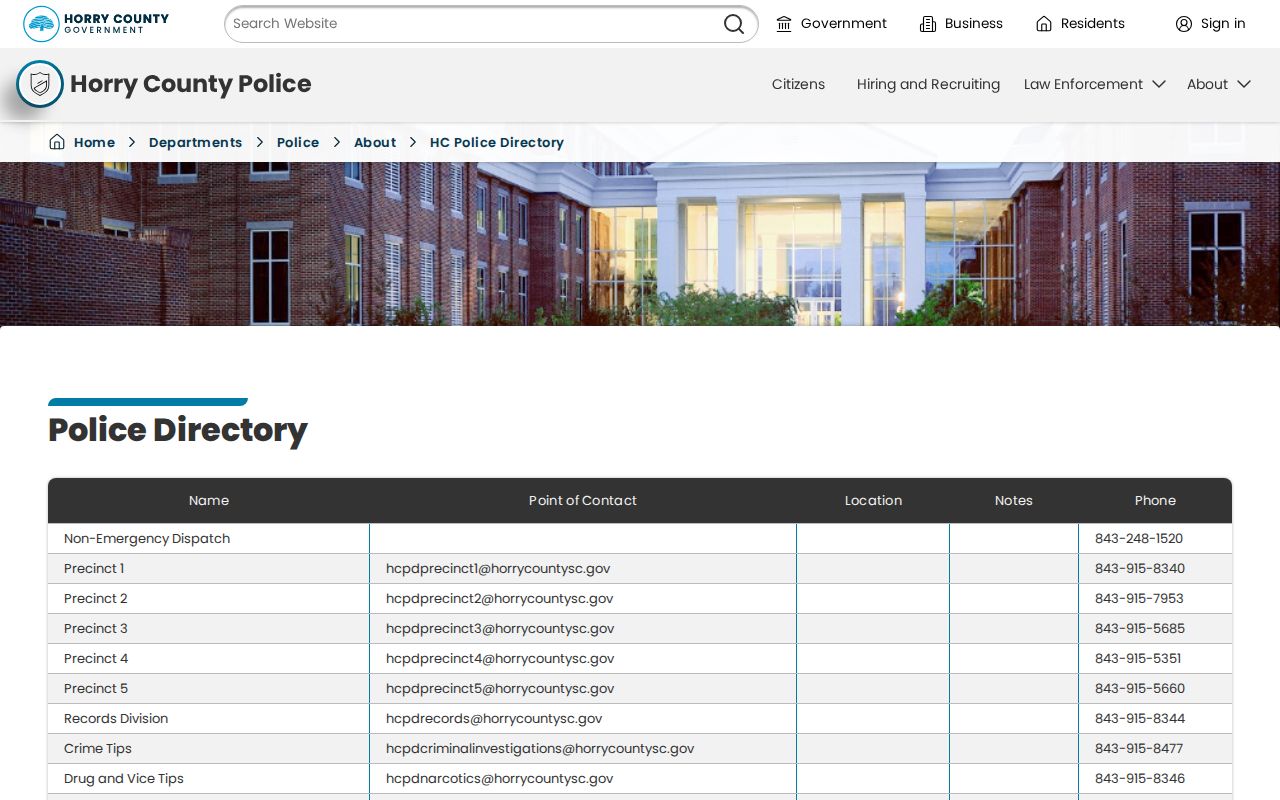
The county directory is a jurisdiction check, not the place to request a report created by Conway Police.
Conway Report Requests Need Detail
Conway routes police information requests through the city FOIA page. A narrow request is more useful than asking for every item linked to a name. State the known report number, date, event location, desired material, and preferred format. If the number is unknown, the address and date can help the city identify the event.
Ask which parts can be released as a routine report and which require formal FOIA processing. A city may redact victim, juvenile, personal, or active-investigation information. Video and larger sets can also require more search and review than a routine incident report. The city determines access under South Carolina law rather than assuming every internal police item is public.
Before filing, verify jurisdiction. An address near Conway can lie outside city limits. The responding agency name on a citation, report receipt, or booking entry is a stronger clue than the postal city.
Note: Conway’s city request should name the precise police record, while a county police record must go to HCPD or Horry County’s FOIA route.
Booking and Arrest Records in Conway
A Conway arrest can generate a city report, a warrant or bond file, a booking entry, and a court case. These products can post at different times and use different charge wording. The police report states the city officer’s account. A booking entry states custody and allegations at intake. The later court file records the charge that was filed and its disposition.
The research does not establish that every Conway arrest follows one automatic booking handoff. Do not write that assumption into the search. Call the city first, then check the official JRLDC booking interface and contact Booking at 843-915-6911 when county intake is possible. A person may appear in the city record before any JRLDC result is posted.
If a JRLDC booking exists, compare its booking number, arresting agency, charge, dates, and warrant reference with the Conway report. The jail entry does not settle the case outcome. Use the proper city or county court for that.
Conway Booking Records Need Confirmation
When the only fact is “arrested in Conway,” confirm three points: the arresting agency, the holding site, and the court named on the bond or citation. City limits are not the same as the broad Conway mailing area. HCPD, state officers, or another agency may make an arrest near the city.
If JRLDC holds the person, the county booking page may show the booking and release dates, custody status, agency, charge, bond, and warrant number. If no entry appears, call Booking rather than assuming no arrest occurred. A web posting can lag, and the city-to-county handoff is not documented as identical in every case.
Quick answer: a JRLDC entry proves a county booking event, not a Conway Municipal Court conviction. Check the docket for the outcome.
The Conway Municipal Court File
Conway Municipal Court separates administration from the courtroom location. Administration is at 206 Laurel Street, Conway, SC 29526. The phone is 843-248-1765 and fax is 843-248-2950. Court is held at 229 Main Street. The city lists Judge Kayla Fleming.
The Municipal Court handles authorized city matters, prepares arrest warrants and affidavits for Conway police, and conducts court proceedings within its jurisdiction. It links both Horry Public Index and online payments. Those links do not mean every city document is downloadable or that every county case belongs to the municipal court.
| Court Name | Conway Municipal Court |
|---|---|
| Case Types Heard | Authorized municipal matters, city warrants, affidavits, and related proceedings |
| Case Lookup Channel | Court administration, linked Horry Public Index where applicable, and eligible online payments |
| What the Docket Shows | Case or citation identifier, events, scheduled action, and disposition as maintained |
| Copies & Fees | Ask administration about availability, certification, and current copy charges |
Provide a citation or case number when available. A person’s name and event date can help when the identifier is missing.
Conway Court Schedules Shape Records
The court reports weekly bench trials and quarterly jury trials. It also holds frequent General Sessions bond hearings. That mix is unusual for a city page because Conway is the county seat. A hearing held in Conway is not always a Conway Municipal Court prosecution.
Read the court name on every notice. A municipal case stays with the city clerk for its local docket. A General Sessions bond hearing can occur nearby while the felony case file belongs to the Horry County Clerk. The General Sessions direct line is 843-915-5084.
The timing matters when a search returns only a payment option or an early event. A bench or jury setting may not yet have produced a disposition. Ask the clerk for current status, then obtain a certified copy if formal proof of the outcome is needed. An online index printout is informational.
How Conway Records Reach the County
Conway police create the first city record. A JRLDC intake, when it occurs, creates a separate Horry County booking. Municipal Court keeps eligible city proceedings, while a felony or higher-level prosecution is maintained in the Court of General Sessions. Qualifying arrest and disposition data may later reach SLED.
Record flow: Conway PD › Conway Municipal Court or Horry County Courts › South Carolina Law Enforcement Division
A recent city report can therefore exist before a county docket or statewide history updates. Start with Conway for the narrative, add JRLDC for county custody, and use the right court for the filed result. For more detail on county case fields and dispositions, use the Horry County Court Case Lookup.
CATCH is useful for a separate statewide name search. It does not contain wanted-person or sex-offender-registry data, and a name match is not positive fingerprint identification. SLED also accepts its official mail form with payment and a stamped return envelope at the Records Department, PO Box 21398, Columbia, SC 29221-1398.
Conway County-Seat Record Hub
The Horry County Government and Justice Center at 1301 Second Avenue houses both the county Clerk counter and the Sheriff’s principal office. Their proximity can be misleading. The Clerk supplies Circuit Court and General Sessions files. The Sheriff handles jail, warrant, court-security, and other assigned records. Neither office keeps Conway police reports merely because the city and county share the same seat.
HCPD headquarters is at the M.L. Brown Public Safety Building, 2560 North Main Street, Suite 7. The county department moved there from the old jail in 1995. The old jail was demolished in 1996 for the Administration/Judicial Complex. That history helps explain why several justice offices sit close together yet retain separate custody of records.
JRLDC is another distinct stop at 4150 J. Reuben Long Avenue. Booking is 843-915-6911. A jail entry answers whether county booking or custody occurred. It does not answer what Conway police wrote or how a filed charge ended.
Conway Record Access Rules
The South Carolina Freedom of Information Act supplies the public request route for city records, but access remains subject to statutory exemptions, redaction, and reasonable agency procedures. Conway can require enough detail to identify the police material and may separate routine reports from records that need formal review.
City police records may omit protected victim, minor, personal-identifier, or active-investigation material. Court systems also withhold sealed, expunged, juvenile, and other confidential matters. A search result is not permission to infer guilt. An arrest is an allegation and custody event; the court disposition states the legal outcome.
Key Statutes:
S.C. Code §30-4-30 establishes public inspection and copy procedures under South Carolina FOIA.
S.C. Code §30-4-40 identifies exempt records and information, including protected law-enforcement material.
S.C. Code §23-3-115 governs state criminal-history dissemination through SLED channels.
Ask the office that created the file. FOIA is the fallback when a routine counter, docket, or purpose-built search does not supply the sought record.
Conway Police or HCPD Records?
The city edge is the chief local trap. Conway Police serves the incorporated municipality. Horry County Police serves the nearby unincorporated county. A Conway mailing label does not prove that Conway officers responded.
When only the occurrence address is known, give that exact site to the city or county records desk and ask which agency had jurisdiction. Look for a department name on any citation, bond paper, temporary report number, or JRLDC profile. That evidence should control where the report request goes.
Myth: every arrest close to downtown produces a Conway police report. Fact: state, county, and city officers can all make arrests in the area, and each keeps its own narrative.
If HCPD handled the event, Records can be reached at 843-915-8344. If Conway Police handled it, keep the request with the city FOIA and police channel. Court and jail checks may still be needed after the correct report is found.