
Horry County Criminal History Checks
No master county file answers every criminal-record question. Start by deciding whether you need current custody, the filed court outcome, a police narrative, or a statewide history. Use a full name, date of birth when the official form permits it, known aliases, an incident or case number, and an approximate event date. Those details help separate people who share a name. They also make calls to Horry County records counters far more useful.
The order matters because each Horry County system records a different stage. A person may appear in the jail roster before a case reaches the court index. A police report may retain the arrest allegation after a solicitor files a different charge. SLED may receive fingerprint and disposition data later. Follow this sequence:
- Check the J. Reuben Long booking channel for current or recent Horry County custody.
- Search the South Carolina Public Index under Horry County for filed charges, events, and dispositions.
- Ask the arresting police agency for its incident or arrest narrative.
- Use SLED CATCH for a printable statewide, name-based South Carolina criminal history.
- Request a certified court copy or fingerprint-supported official result when identity or formal proof matters.
The official Horry County government directory is the source for current department routes. Its county page is pictured below.
The directory helps confirm which Horry County office owns a record before a search or request begins.
Three Horry Records, Three Answers
JRLDC, Public Index, and SLED CATCH are related, but they are not duplicates. The booking portal answers whether a person entered local custody and shows the allegations recorded at intake. Public Index follows a court case through charges, events, plea or trial, disposition, and sentence. CATCH assembles fingerprint-supported South Carolina arrest and conviction data. It excludes wanted-person and sex-offender information.
A mismatch is not automatically an error. Arrest charges can change after the solicitor reviews a file. Recent fingerprints or court outcomes may not have reached the repository. Aliases and similar names can also distort name-search results. Compare dates, agency names, case numbers, and charge statutes. For the final case outcome, the Horry County Clerk record carries more weight than a booking allegation.
| Horry record channel | Best question | Main limit |
|---|---|---|
| JRLDC booking search | Was the person booked or recently released? | Custody and allegations do not prove guilt. |
| Public Index | What charge was filed and how did it end? | Not every document is downloadable. |
| SLED CATCH | What fingerprint-supported history is reported statewide? | Name matching is not positive identification. |
Note: An empty result in one Horry County system does not clear a person in the other two systems.
Official Background Checks in South Carolina
The South Carolina Law Enforcement Division runs Citizens Access to Criminal Histories, known as SLED CATCH. A public name check uses first name, last name, and date of birth; middle name and Social Security number may help narrow a match. The charge is $25, plus the processor fee stated by the portal. CATCH is South Carolina-only. SLED warns that a name and birth date can still produce a false match or miss a record filed under different identity data.
For self-review, the mail route uses SLED's form, certified funds, and a self-addressed stamped envelope. The sender must ask if a certified or notarized result is needed. SLED's Records Department does not take public walk-in requests. When a statute calls for fingerprints, Horry County Police can capture ink cards at its five precincts. The local card service does not itself produce the SLED result.
The SLED CATCH search entry shows the terms and payment path used for a South Carolina criminal record.
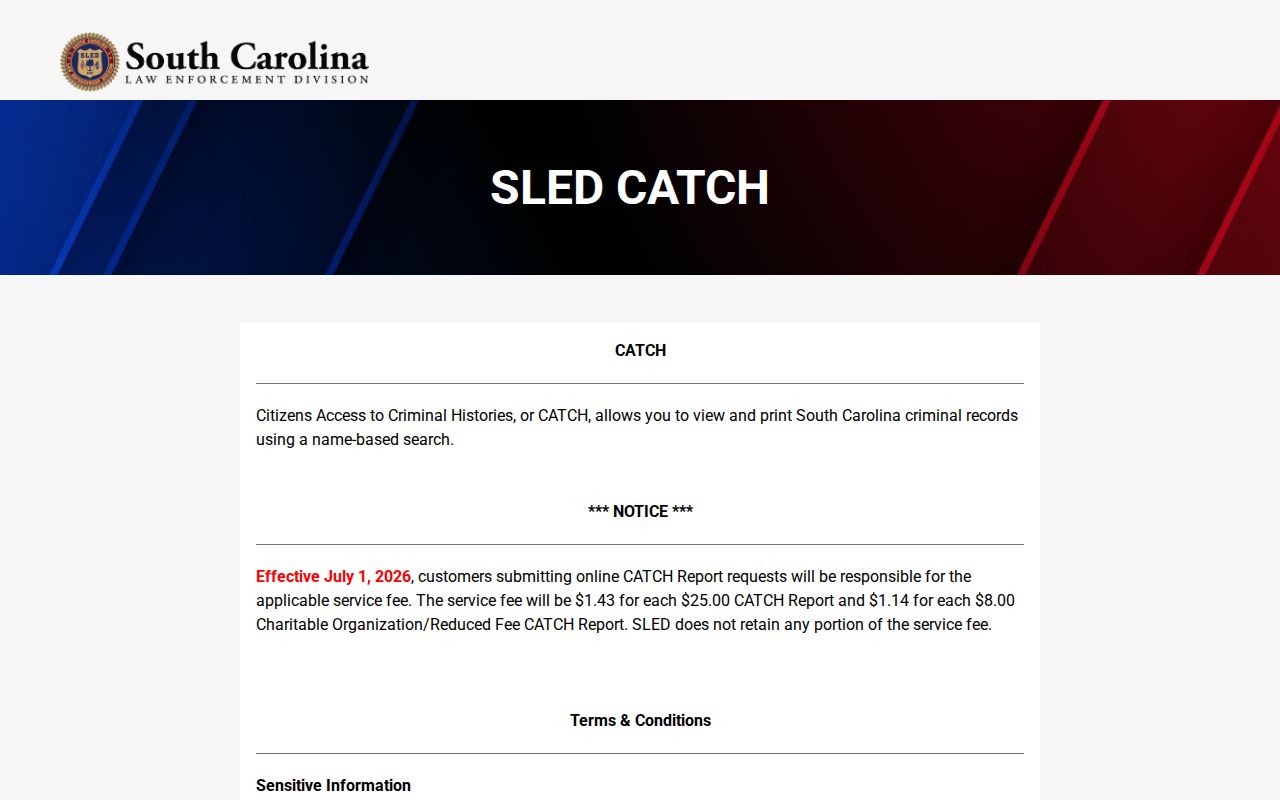
This screen marks the start of the state repository check, not a county court or warrant search.
| Service | Published cost | Key condition |
|---|---|---|
| SLED CATCH name report | $25 plus stated online fee | South Carolina history; name-based match |
| SLED mail report | $25 | Certified funds and self-addressed stamped envelope |
| First HCPD fingerprint card | $10 exact cash | Capture service only |
| Each added fingerprint card | $5 exact cash | Hours vary by precinct |
Five Horry Criminal Records Counters
Horry County Police serves unincorporated areas and accepts routine report-copy and fingerprint requests at five weekday precinct counters. Central is in Conway, South and Precinct 5 serve Myrtle Beach-area locations, North is in Longs, and West is in Green Sea. All list weekday hours from 8 a.m. to 5 p.m., but fingerprint hours vary. Records Division can be reached at 843-915-8344.
An involved person may receive an HCPD report at no charge by showing identification plus a case number or the address and date of the event. That person may also email the identifiers and a copy of ID. A requester not named in the report must visit a precinct, pay $2 in exact change, and accept required redactions, or use Horry County FOIA. Multiple reports and larger record sets go through Public Information.
The county's HCPD Citizens page is the official source for report copies and fingerprint services.
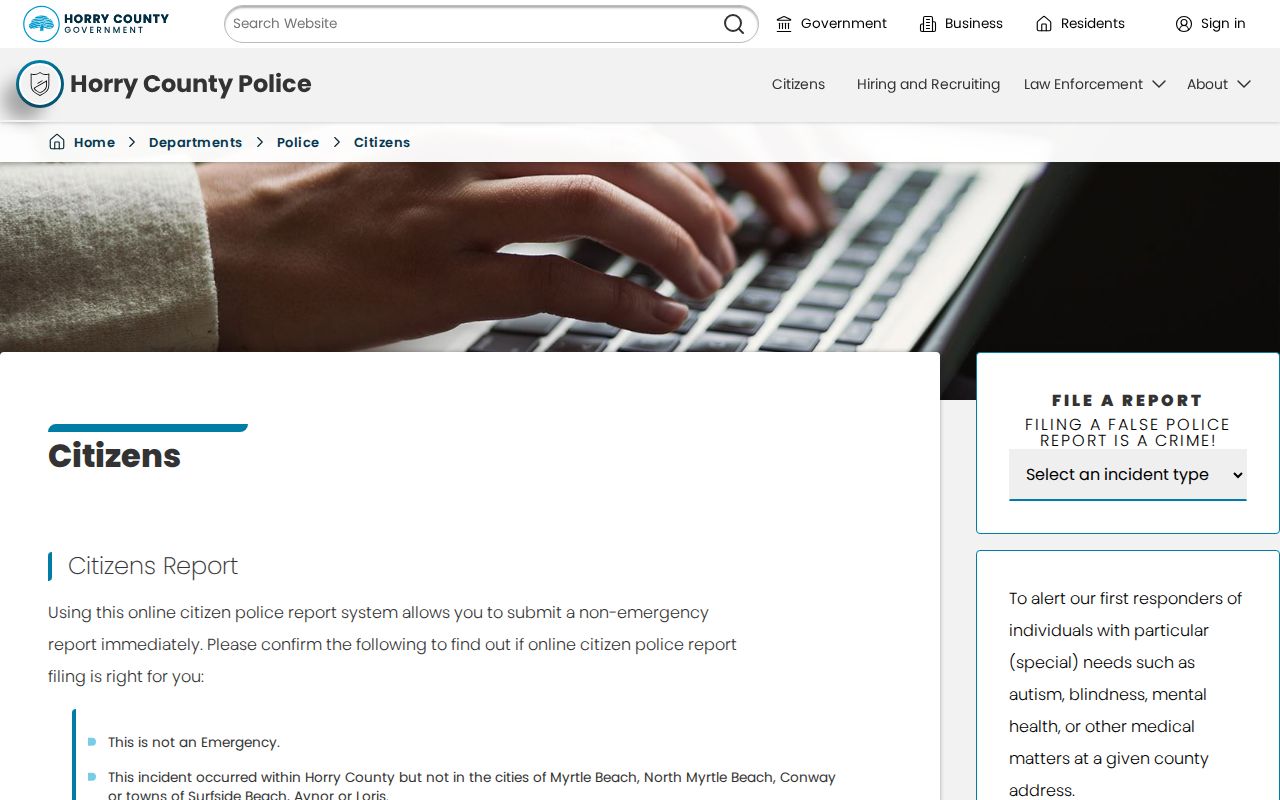
That service page helps readers distinguish a police narrative request from a jail or court lookup.
The HCPD patrol directory shows the five current precinct locations.
The precinct network matters in a county that spans inland communities and the Grand Strand.
Kinds of Criminal Records
Horry County criminal records are created in stages. The agency responding to an event writes an incident or arrest narrative. JRLDC creates the booking record, fingerprint transaction, photograph, charges, bond, and custody events. A magistrate records the first appearance and bond decision. The Clerk maintains the filed court case. SLED later compiles qualifying state history from fingerprint and disposition reports.
Other systems answer narrower questions. The sheriff and police warrant units handle different warrant work. SCDC tracks people committed to state prison. SCDPPPS manages probation and parole supervision. SLED publishes the state sex-offender registry, while Horry County Sheriff performs local registration and verification.
- Police report: the responding agency's account of an alleged event.
- Booking record: local intake, charges, bond, and custody status.
- Court case: filed charges, hearings, outcome, and sentence.
- Repository history: SLED's fingerprint-supported state compilation.
- Corrections record: county jail, state prison, or supervision status.
Horry Records: Clerk or Sheriff?
The Horry County Government and Justice Center places the Clerk of Court and Sheriff's principal office at the same Conway address, yet their records duties differ. The Clerk supplies Circuit Court and General Sessions case files. The Sheriff handles warrants, court security, civil process, the jail, and local sex-offender registration. HCPD, a separate county police department, holds the incident reports written by its officers.
For a certified disposition or an older General Sessions file, call the General Sessions counter at 843-915-5084. The main Clerk line is 843-915-5080. The South Strand Clerk counter at 9630 Scipio Lane offers a coastal option, but callers should verify whether a particular archived or certified criminal file is available there. A warrant question belongs with the issuing court or the appropriate warrant unit, not the Clerk's general record desk.
The Horry County Clerk page links the court search and lists its counters.
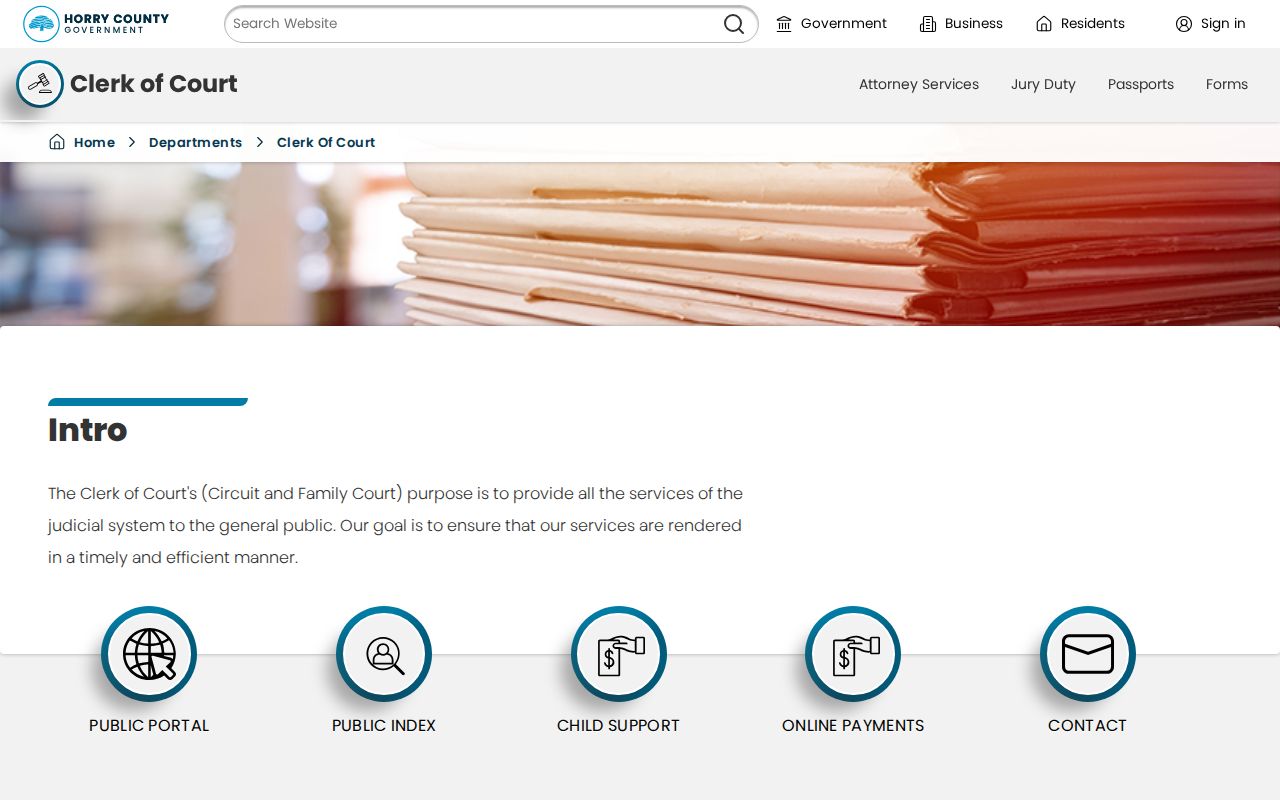
The Clerk source is the route for the case outcome that a booking or police narrative cannot supply.
Clerk of Court
1301 Second Avenue
Conway, SC 29526
843-915-5080
Weekdays, 8 a.m. to 5 p.m.
HCPD Records
2560 North Main Street, Suite 7
Conway, SC 29526
843-915-8344
Weekdays, 8 a.m. to 5 p.m.
JRLDC Booking
4150 J. Reuben Long Avenue
Conway, SC 29526
843-915-6911
Call for current booking questions.
Horry County Criminal Records: What They Contain
A repository history begins with reported identity data and groups events into arrest cycles. A court file adds the docket sequence, filed statutes, attorneys, hearings, and outcome. The jail view adds booking, release, bond, and custody fields. Read the source label before treating any field as final. Full birth dates, Social Security numbers, victim or minor information, financial account data, and sealed material should not appear in a public view.
| Name and identifiers | Reported names, aliases, date or age fields, state identifiers, and fingerprint-linked transaction data. |
|---|---|
| Arrest and booking | Agency, date, incident or booking number, intake charges, bond, and release status. |
| Charges and statutes | Offense text, code section, count, indictment, warrant, or citation reference. |
| Disposition | Pending, dismissal, nolle prosequi, plea, verdict, conviction, acquittal, or other posted result. |
| Sentence | Custody, probation, fines, costs, restitution, and concurrent or consecutive terms where posted. |
| Custody or supervision | JRLDC or SCDC custody and the court order imposing SCDPPPS supervision. |
Note: Read every charge line because one Horry County case can contain several counts with different outcomes.
Horry Court Record Name Checks
Public Index first asks the user to select Horry County. An exact case number is the cleanest search. With only a name, enter the surname and first name, then narrow by party type, criminal case type, or date range if those controls appear. Compare the filing date and charge details before assuming a result belongs to the right person.
An index line is not a promise that a document image is online. Older files, certified copies, and unclear entries may require the Clerk counter. Lower magistrate and city matters may also remain outside General Sessions. The deeper Horry County court case lookup explains those court boundaries.
| Search field | Use | Horry record tip |
|---|---|---|
| County | Selects the local index | Choose Horry before searching. |
| Case number | Exact identifier | Use it when known. |
| Last and first name | Party search | Check spelling and similar names. |
| Party type | Narrows role | Choose defendant where offered. |
| Court or case type | Narrows docket | Focus on criminal or General Sessions. |
| Date range | Limits filing events | Availability varies by module. |
South Carolina Public Access Laws
South Carolina FOIA gives the public inspection and copying rights subject to exemptions, response rules, and lawful fees. Horry County directs routine records to the office that made them, while its Public Information channel handles broader or unusual requests. That is often faster and more precise than sending every request through FOIA.
Access has limits. Agencies may withhold active investigative detail, confidential victim or minor information, personal identifiers, juvenile files, and expunged material. Court electronic-access rules also govern what appears online. Public access does not turn an arrest into proof of guilt, and registry access carries its own lawful-use conditions.
Key laws:
S.C. Code §30-4-30 sets FOIA inspection, copy, response, and fee rules; §30-4-40 lists exemptions.
S.C. Code §§23-3-115 and 23-3-120 govern SLED dissemination and fingerprint arrest reporting.
South Carolina Appellate Court Rule 610 governs electronic court filing and access policy.
S.C. Code §17-1-40 covers relief for certain non-conviction records.
Horry Jail and State Records
JRLDC holds pretrial detainees, some sentenced inmates serving 90 days or less, and Family Court commitments. After a person is committed to state prison, the county booking search may no longer answer the custody question. The SCDC locator then becomes the right source. Home Detention is a third track, using GPS and SCRAM monitoring while the person remains in a jail-administered status.
The SCDC Incarcerated Inmate Search is the official state-prison locator for a Horry County criminal case that has moved beyond local custody.
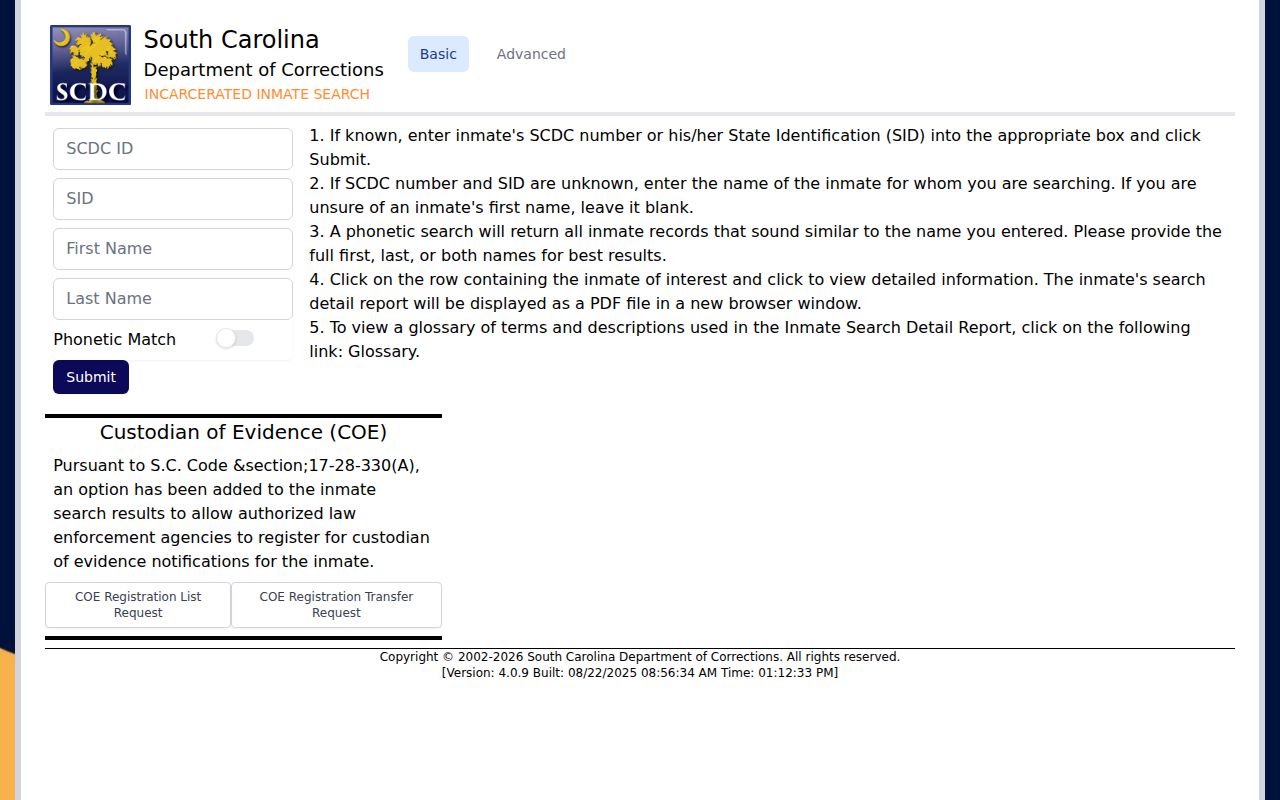
The SCDC view should be checked apart from the Horry County jail roster because each covers a different custody system.
The South Carolina probation and parole agency supplies the official supervision framework.
SCDPPPS maintains operational supervision files, while the Horry court docket shows the sentence or later revocation event.
Restricted, Sealed & Expunged Records
South Carolina limits access to juvenile files, protected personal data, active-investigation material, and records covered by an expungement order. A dismissal alone does not always remove every public trace. Eligibility depends on the exact charge, outcome, past history, waiting period, and completion of all conditions.
Horry County's Fifteenth Circuit Solicitor expungement office is at 1301 Second Avenue in Conway and can be reached at 843-915-8624 on weekdays. Its screening form asks for identity details and charge identifiers. The office says it will send eligibility instructions or a denial reason by email within three business days, while a completed eligible process can take up to four months. Where charges apply, state forms list separate solicitor, SLED, and Clerk amounts.
After an order, copies go to the listed court and justice agencies. Update times can differ. Check both Horry Public Index and your own SLED history before assuming the change has reached every system. Material already published by media or private publishers is outside the county's removal power.
Horry County Warrant Record Checks
CATCH does not contain wanted-person information, and an empty court name search is not warrant clearance. The Horry County Sheriff Warrant Division lists 843-915-8347. HCPD separately lists its Warrants unit at 843-915-5688. Municipal courts may issue and manage their own bench warrants. Call the serving unit and the issuing court with the exact name and case or warrant number when available.
For your own possible warrant, confirm the issuing court, charge, service status, and bond directions before acting. Payment methods and surrender procedures differ. Do not depend on a third-party warrant site. A warrant may also be sealed during an active investigation, and a served or cleared status may take time to update across police, jail, court, and state systems.
Own warrant concern: Contact the issuing court or Horry warrant unit for safe, current instructions. Do not treat a blank portal result as clearance.
City-by-City Criminal Records in Horry County
Myrtle Beach, Conway, and North Myrtle Beach maintain city police and municipal court records apart from HCPD and General Sessions. Follow the location of the event and the responding agency, not the postal city alone. A city arrest may create a city police report, a Horry County jail entry, and either a municipal or General Sessions case.
Myrtle Beach Record Check
40,535 estimated residents · MBPD Records, P2C, and Ted C. Collins Municipal Court.
Conway Record Check
29,656 estimated residents · City police, Municipal Court, and county-seat record offices.
North Myrtle Beach Record Check
20,798 estimated residents · NMB Police, city FOIA, Municipal Court, and county booking route.
Horry Criminal Records Across Jurisdictions
Horry County's records map is unusual because HCPD and the Sheriff are distinct. The county police began by legislative act in 1959 and describes itself as South Carolina's only remaining county police department. It writes reports for unincorporated areas. The Sheriff manages JRLDC, warrants, court security, and local registry work. Incorporated coastal cities keep their own police files.
Federal criminal cases add another layer. They run through the U.S. District Court for the District of South Carolina and PACER, not Horry Public Index. Federal custody is tracked through the Bureau of Prisons. The FBI Identity History Summary is a fingerprint-based self-record product and does not replace a county court, jail, or SLED search.
The District of South Carolina is the source for federal court information connected with Horry County.
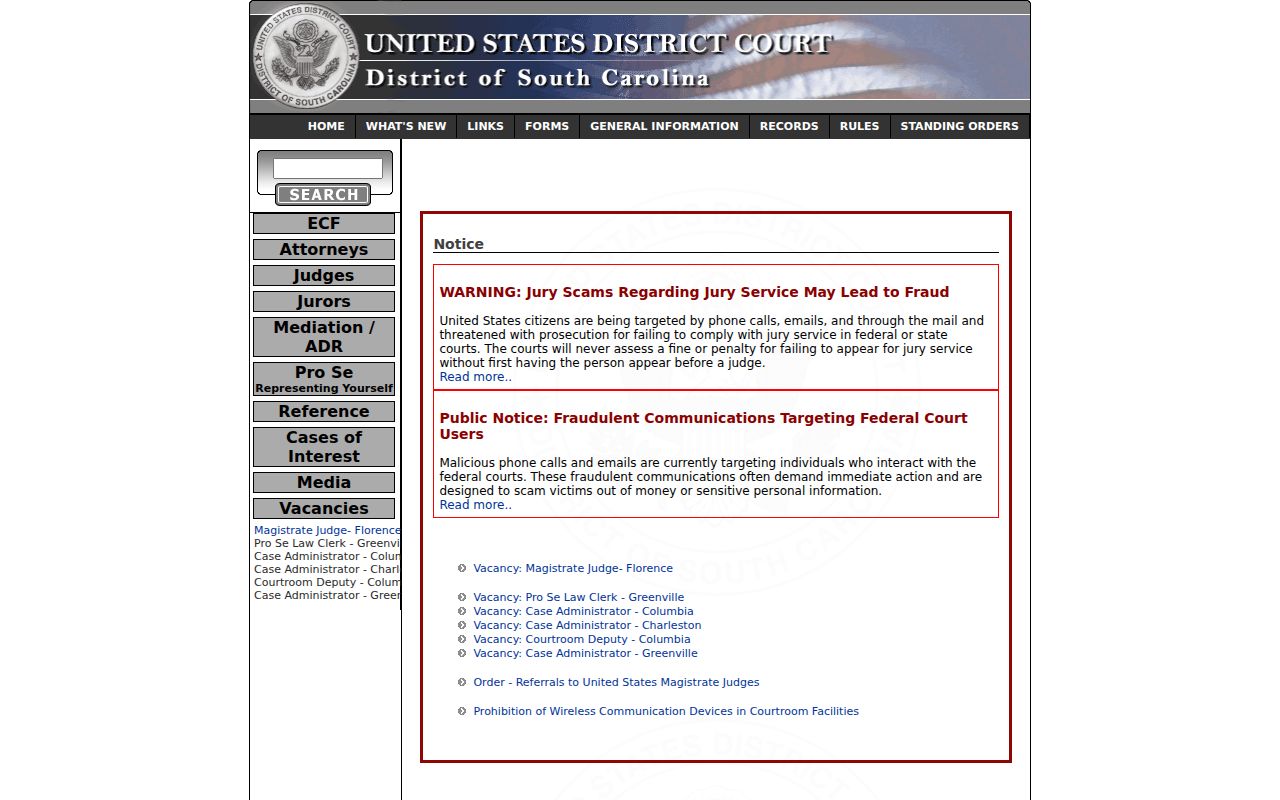
Federal dockets belong to this separate court system even when the events occurred inside Horry County.
The Federal Bureau of Prisons locator covers federal custody.
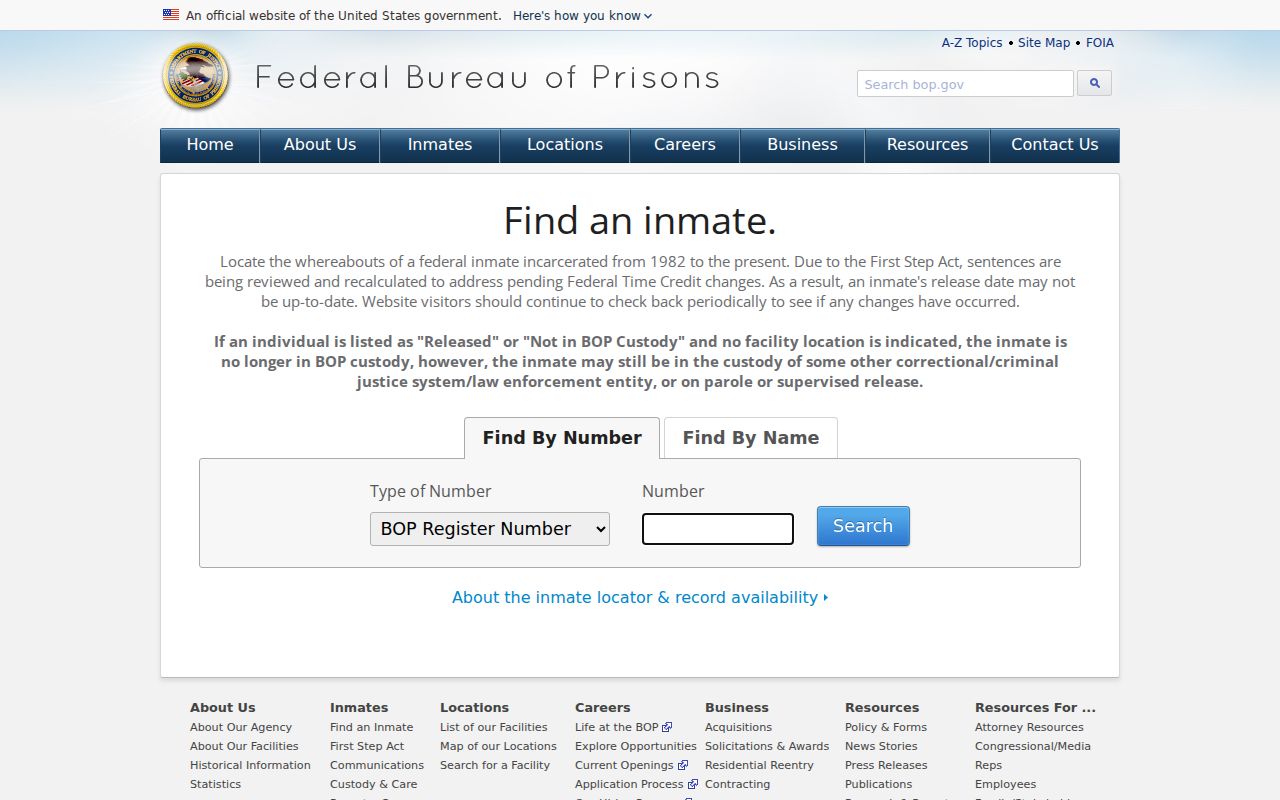
The BOP result answers a federal custody question, not a JRLDC booking or SCDC sentence question.